Negative spherical aberration (SA) is good for
reading glasses, but positive SA is not
Ai-Hou Wang, M.D. Ph.D.
For reading glasses, if the 360-degree
periphery was made less positive (or more negative) (i.e. negative SA), it will
extend the range of vision to middle-distance. It is good
(1)
for desktop work – you can
read document and at the same time see clearly the desktop computer.
(2)
for presentation at conference
– on the stage you can read document or computer screen and at the same time
see the audience not so blurredly.
Conversely, if the 360-degree periphery of a
middle-distance glasses was made more positive (or less negative) (i.e.
positive SA) (you may try with Zeiss MyoVision), it
won’t help reading documents at near.
This is my observation, but I don’t have
satisfactory physiological interpretation for it.
‘Why could our perception utilize negative SA for
a range distance of vision while not the positive SA?’
Any optics guru would apply wavefront to answer
this question?
Negative SA:
Central part for near (more
positive or less negative)
Periphery for distance (less
positive or more negative)
Positive SA: (for example, Zeiss MyoVision)
Central part for distance
(less positive or more negative)
Periphery for near (more
positive or less negative)
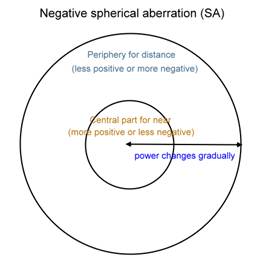
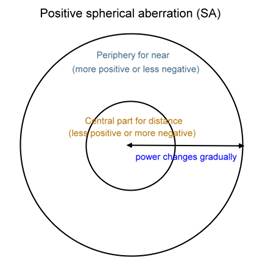
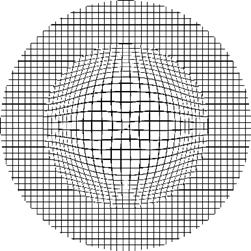
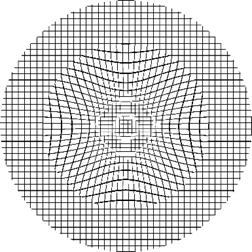
(Both negative SA and positive SA are
360-degree symmetrical.)